The Physics of a Step: How Mechanical Engineering Is Redesigning Human Walking
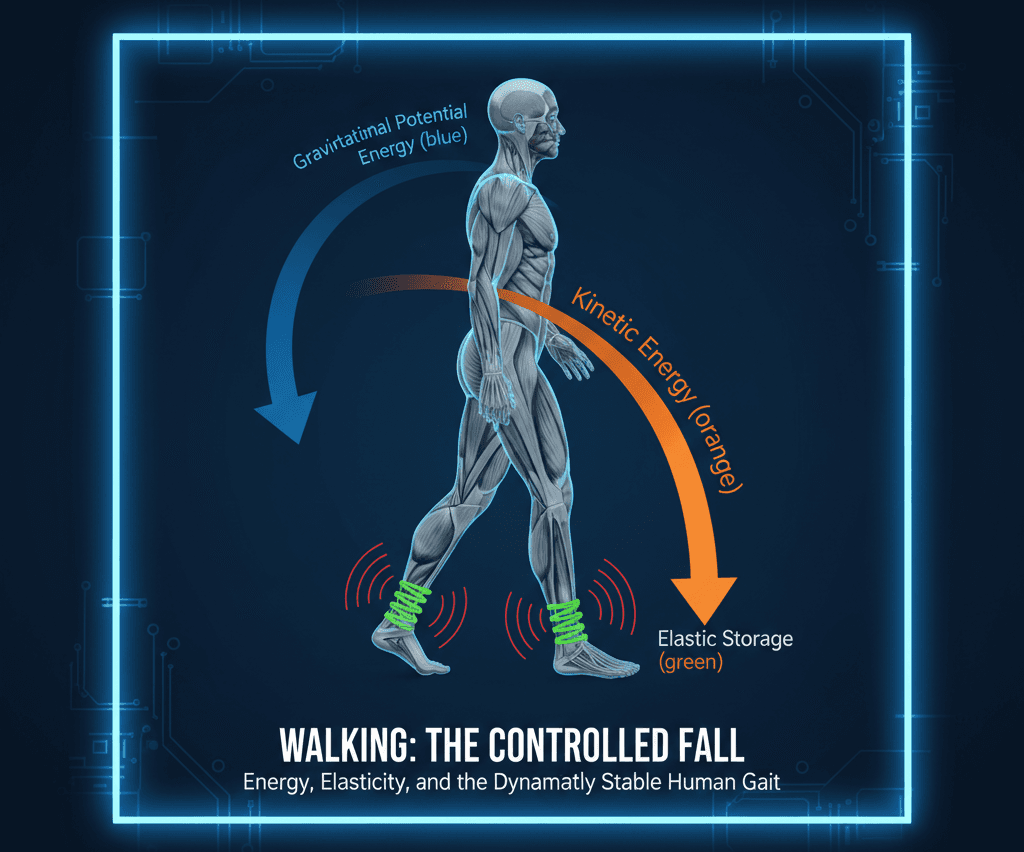
Walking looks simple. In mechanical terms, it is anything but. Each step is a controlled fall, a continuous exchange between gravitational potential energy, kinetic energy, elastic storage, and dissipation. From the viewpoint of physics and mechanical engineering, human gait is a dynamically stable system operating near optimal efficiency. Understanding and improving it has become one of the most elegant challenges in modern engineering.
Walking as a Controlled Dynamic System
At its core, walking is governed by Newton’s laws. The body’s center of mass vaults over the stance leg much like an inverted pendulum. Gravitational torque drives forward motion, while muscles act as actuators that regulate stability and direction. Mechanical engineers describe this using Inverted pendulum dynamics during single support, collision mechanics at heel strike, where kinetic energy is partially dissipated, and periodic muscle forcing to sustain motion. The energetic cost of walking is dominated not by forward motion, but by the mechanical work required to redirect the center of mass between steps. Reducing this redirection work is a primary target for gait optimization.
Energy Exchange and Efficiency
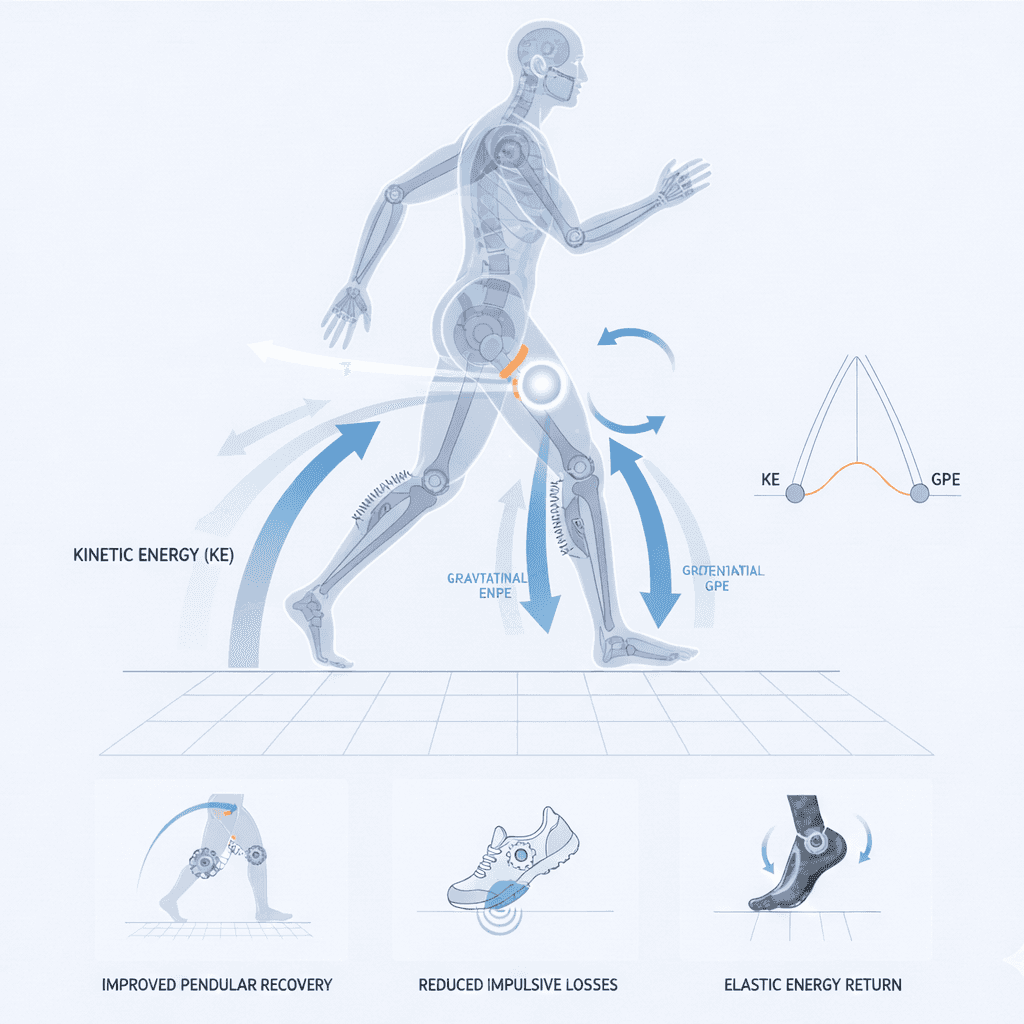
Human walking is surprisingly efficient because it exploits passive energy exchange. During a step Kinetic energy decreases as the body rises, Gravitational potential energy increases and the process reverses during descent. This out-of-phase exchange resembles a conservative mechanical oscillator. When the exchange is well-timed, muscles perform minimal network. Deviations caused by injury, aging, or poor mechanics break this exchange and increase metabolic cost.
Mechanical engineering interventions aims to Improve pendular energy recovery, reduce impulsive losses at foot-ground collision and Store and return energy elastically using compliant elements.
Joint Mechanics and Load Distribution
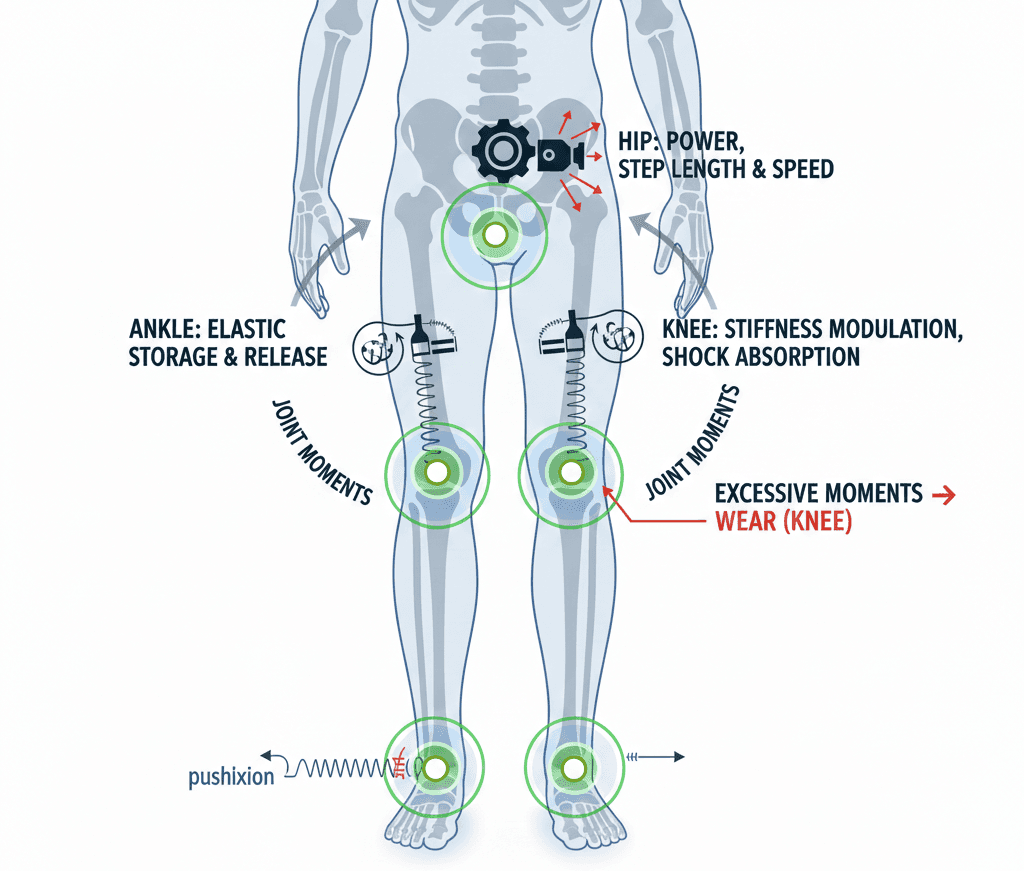
Each lower-limb joint behaves like a variable-stiffness rotational spring-damper system. The ankle stores elastic energy during dorsiflexion and releases it at push-off. The knee modulates stiffness for shock absorption and stability. The hip provides power to regulate step length and speed. Excessive joint moments increase wear, particularly in the knee. Engineering solutions focus on altering moment arms, effective stiffness, or timing to redistribute loads without compromising stability. From a mechanical standpoint, improved walking often means lower peak torques rather than lower average forces.
Passive Dynamics and Minimal Control
One of the most influential insights in gait engineering is that stable walking does not require continuous active control. Passive dynamic walkers, mechanical systems with no motors and no control algorithms, can walk down a slope using gravity alone.
These systems demonstrate that Proper mass distribution and geometry can generate natural gait patterns. Active control is needed primarily for disturbance rejection, not steady walking. Modern assistive devices borrow from this principle, using springs, clutches, and tuned inertia to align with natural dynamics rather than override them.
Engineering Interventions: Adding Mechanics, Not Complexity
Footwear
From a physics perspective, shoes modify boundary conditions at the foot-ground interface. Rocker soles reduce the required ankle moment by altering the effective pivot point. Compliant materials reduce impact impulses by increasing collision duration.
Prosthetics
Advanced prosthetic feet behave like tuned elastic beams. By matching stiffness to walking speed and user mass, engineers maximize elastic energy return and minimize external work.
Exoskeletons
Exoskeletons act as parallel mechanical pathways. Properly designed, they offload joint torque at precise phases of gait, reducing muscular power without increasing control effort. The key variable is phase-dependent impedance, not raw actuator power.
Stability, Perturbations, and Control
Walking stability is often misunderstood. Static stability is irrelevant; dynamic stability is everything. Engineers quantify this using Floquet theory for periodic systems, Lyapunov exponents to assess sensitivity to perturbations, and Step-to-step variability as a stability metric. Improving walking means increasing robustness to disturbances, uneven terrain, slips, or fatigue, while preserving energy efficiency. This is a classic control-mechanics trade-off.
Scaling Up: Surfaces and Infrastructure
Even the ground matters. Hard surfaces increase impact impulses; overly soft surfaces increase muscular work. Optimal walking surfaces strike a balance between compliance and energy loss. Urban engineering can therefore influence gait by controlling Surface stiffness, Friction coefficients and Geometric discontinuities.
From a mechanical standpoint, better walking environments reduce external disturbances, allowing the human system to operate closer to its natural dynamic optimum.
The Engineering Direction Forward
Future gait engineering will increasingly resemble structural dynamics and vibration control. Adaptive stiffness elements that tune to walking speed, Energy-harvesting devices that recycle dissipated work, and human–device systems modelled as coupled oscillators. The ultimate goal is not to force new walking patterns, but to reshape the mechanical landscape in which walking occurs, so the body naturally selects better ones.
Final Thoughts:
Seen through the lens of physics and mechanical engineering, walking is an elegant solution to a difficult problem: how to move a tall, unstable structure forward efficiently under gravity. Engineering improves walking not by adding more control, but by respecting the underlying mechanics, aligning forces, timing energy exchange, and letting physics do as much of the work as possible.
Better walking, in the end, is better mechanics
-By Dr. Deepak Kumar Pandey