Beyond the Lancet: Humane Diagnostics in the Age of Artificial Intelligence
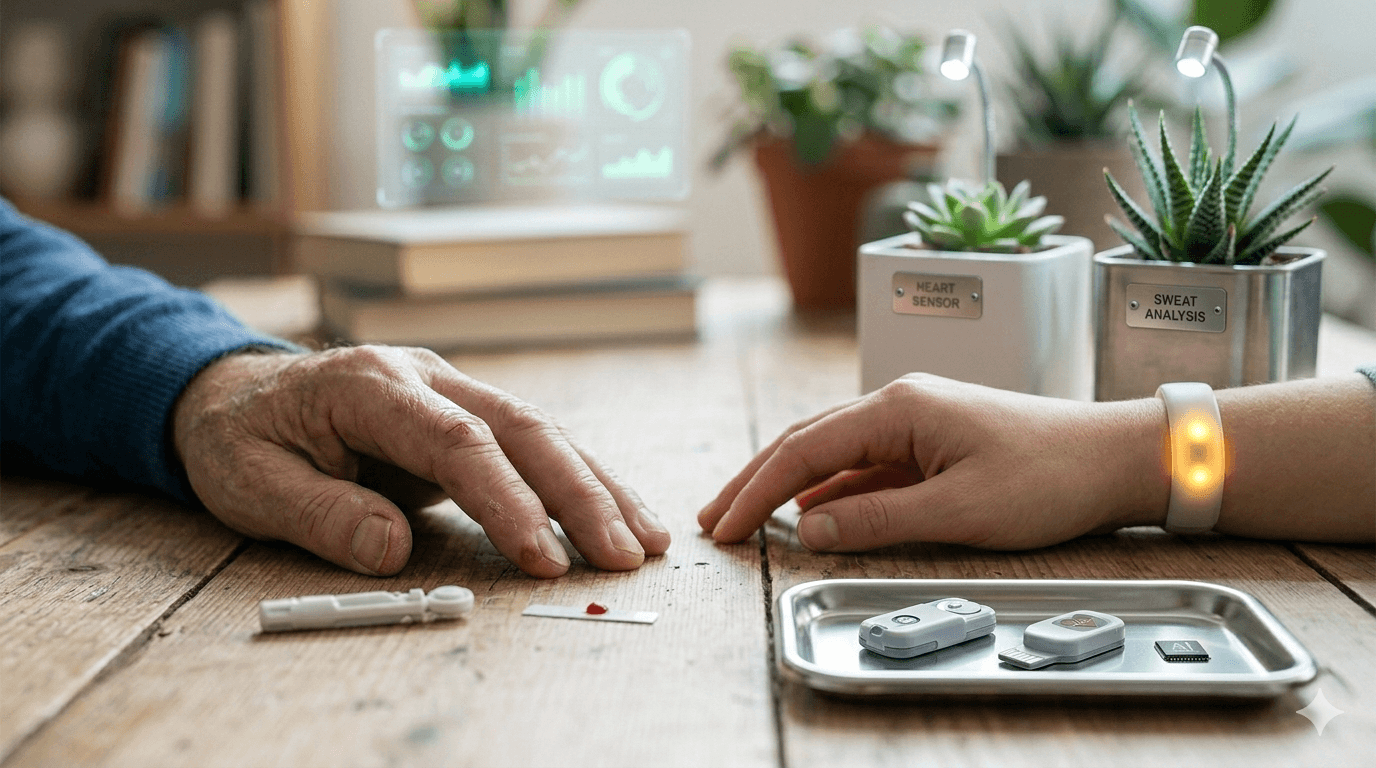
A lancet pricked his bony finger. He squeezed once. Nothing. On the second squeeze, a faint bead of blood appeared. His hands were shaking as he tried to guide the drop onto the narrow strip of the glucose monitor, but it smeared across the metal surface. An error message and a failed reading.
At ninety years old, my grandfather sighed and reached for another finger. The second prick drew a quiet wince. In his eyes, I saw something heavier than pain. Fatigue, frustration, and a quiet resignation. This had been his routine for five years. Morning and evening. A ritual of injury in the name of survival. Every month, he went for laboratory tests. He fasted beforehand, weak and irritable by mid-morning. By the time he returned home, after blood draws and waiting rooms, he looked depleted. In India, sample collection can now happen at the doorstep. Logistics have improved. But the needle remains. Blood must still be drawn. Fasting is still required. The body must still be punctured to prove it is functioning.
Watching him struggle, a question began to grow in my mind. Why must monitoring health require injury?
Healthcare has made remarkable advances in therapeutics, surgery, and imaging. Yet, everyday diagnostics, the act of measuring health, often remain invasive, uncomfortable, and infrastructure-heavy. Non-invasive diagnosis is not a futuristic luxury. For the elderly, for children, for patients with chronic disease, it is a matter of dignity. Repeated needle pricks cause calloused fingertips, bruised veins, anxiety, and reduced compliance. The discomfort becomes normalized, but that does not make it acceptable. The goal is straightforward in concept, complex in execution: Extract clinically meaningful biomarkers without wounding the patient in the process.
Current Frontiers in Non-Invasive Research
Wearable optical sensors have matured faster than most people realize. During the COVID-19 pandemic, oxygen saturation tracking moved from hospital wards to wrists. Photoplethysmography (an LED shining light into your skin, a photodetector reading the reflected signal, an algorithm counting peaks) became a household technology almost overnight.
The engineering is sound. An LED emits light into the subcutaneous tissue. Hemoglobin absorbs light differently depending on its oxygenation level. A photodetector measures the reflected signal, and each cardiac cycle produces a distinct waveform. Count the peaks, calculate the rate.
For SpO₂ and heart rate, the signal-to-noise ratio is manageable. The waveform is strong, the periodicity is predictable, and motion artifacts (while still a problem) can be filtered with decent algorithms. We've tested this ourselves: a $30 fitness tracker measures resting heart rate within ±5 bpm of a medical-grade chest strap. Not perfect, but clinically useful for trending.
But oxygen and heart rate are the easy wins. The real challenge is glucose.
Glucose: Where the physics gets difficult
Glucose monitoring is the daily burden of millions. It's also the problem where non-invasive sensing keeps hitting walls.
The approaches under active development tell the story of how hard this is:
Sweat-based microfluidic patches collect minute volumes of perspiration and analyze biomarkers in real time. The engineering challenge isn't collection, it's correlation. Sweat glucose concentrations fluctuate differently from blood glucose. Environmental temperature, hydration levels, and skin chemistry introduce variability that's difficult to calibrate out. The sensor works. The biology doesn't cooperate.
Near-infrared spectroscopy attempts to measure glucose absorption directly through the skin. The problem: glucose absorbs NIR light very weakly compared to water. At physiological concentrations (4–8 mmol/L), the glucose signal is roughly 1/10,000th of the water signal. Extracting that from noise, across different skin tones, hydration levels, and ambient temperatures, is an extraordinary signal processing challenge.
Raman spectroscopy offers better molecular specificity. When monochromatic light scatters off glucose molecules, the frequency shift is unique and identifiable. But the Raman signal is incredibly weak; roughly one in every ten million photons undergoes Raman scattering. Making a sensor that's both sensitive enough to detect this and small enough to wear on a wrist is the engineering bottleneck. The common thread: the fundamental physics works. The engineering to make it reliable, portable, and affordable at medical-grade accuracy is where every approach stalls.

Other diagnostic windows:
Blood isn't the only source of clinical information. Saliva carries hormonal and inflammatory signals. Urine contains markers for early kidney dysfunction. [2] Interstitial fluid (the liquid between cells) tracks blood glucose with a 5–15 minute lag, and continuous glucose monitors already use this approach with a tiny subcutaneous filament.
The idea is compelling: what if routine organ function could be screened without venipuncture? What if early warning came quietly, through passive monitoring rather than episodic blood panels?
The promise is enormous. The obstacles are equally real. Biology is noisy. Peripheral biomarkers don't always mirror central physiology. Calibration across age groups, ethnicities, and comorbid conditions is complex. And regulatory approval requires rigorous validation across populations, not just lab results on healthy 25-year-olds.
Where AI enters and where it overreaches
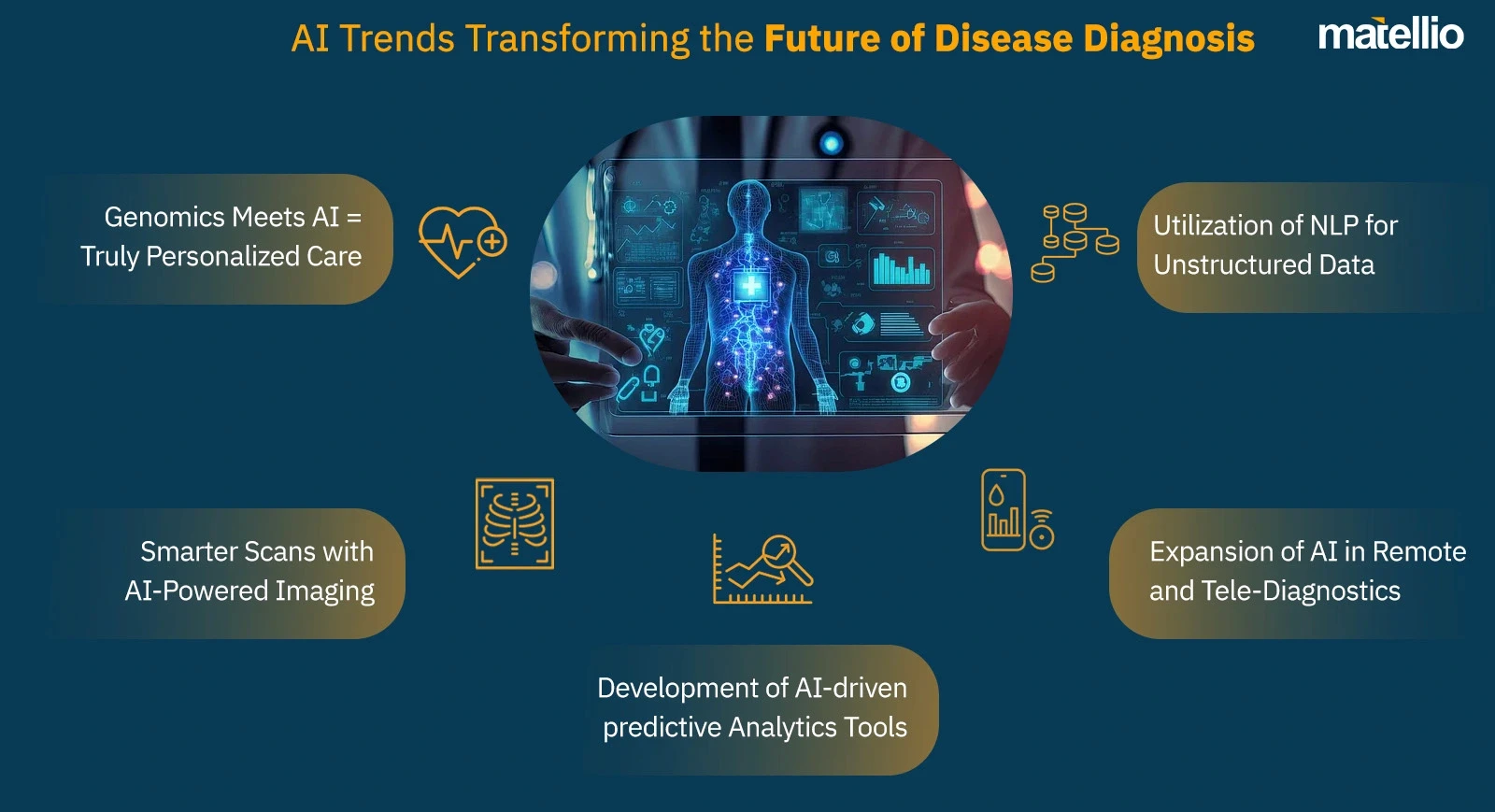
Artificial intelligence is frequently presented as the force that will make all of this work. Continuous streams of data (heart rate, oxygen saturation, glucose trends, sleep cycles) are analyzed to detect deviations from personal baselines. Subtle patterns invisible to clinicians are becoming predictive signals. Diagnosis shifting from reactive to preventive.
Some of this is real. ML models trained on large longitudinal datasets can detect atrial fibrillation from PPG waveforms with sensitivity exceeding 95%. That's not hype, that's peer-reviewed clinical validation.
But the disclaimers matter. Models are only as reliable as the data they're trained on. A model trained predominantly on light-skinned populations will underperform on darker skin tones, and for optical sensing, skin pigmentation directly affects signal quality. Bias in datasets leads to inequitable performance. False positives create anxiety. False negatives create false reassurance. And then there's the problem nobody wants to talk about at the product launch.
Health data are not just numbers. They're intimate reflections of vulnerability. A smartwatch that tracks oxygen, heart rate, and glucose over months accumulates a biological biography. From those patterns, inferences can be made about cardiovascular risk, metabolic disorders, stress levels, medication adherence, and even lifestyle habits.
If such data are aggregated and monetized, they could influence insurance premiums, claim approvals, targeted pharmaceutical marketing, or employment screening. The same systems designed to protect health could quietly stratify risk in ways patients never explicitly consented to.
My grandfather's trembling hands were visible suffering. A needle prick is tangible. Digital extraction is quieter.
The engineering imperative
Non-invasive diagnostics promise a more humane future, fewer punctures, fewer fasting mornings, fewer exhausted returns from clinics. They aim to preserve dignity while improving early detection. For aging populations and low-resource settings, this shift isn't a luxury. It's essential.
But technological progress must be matched with ethical restraint. The goal is gentler medicine and broader access to better health. Not a new form of extraction, quieter than a needle, but potentially deeper.
"The question isn't just whether we can measure health without wounding the patient. It's whether we can do it without exposing them to something worse".
References
[1] Wearable optical sensors for continuous health monitoring. Healthcare Industry Solutions, SO Development. https://so-development.org/healthcare-industry-solutions/
[2] Research in sweat-based glucose monitoring, interstitial fluid sensing, and alternative diagnostic biomarkers. Healthcare Industry Solutions, SO Development. https://so-development.org/healthcare-industry-solutions/
[3] Near-infrared spectroscopy and Raman scattering techniques for non-invasive glucose estimation. Healthcare Industry Solutions, SO Development. https://so-development.org/healthcare-industry-solutions/
[4] AI and machine learning applications in disease diagnosis, including PPG-based atrial fibrillation detection. Matellio. https://www.matellio.com/blog/ai-in-disease-diagnosis/
Image Attribution
Header image 1: Image by Lifestylememory on Freepik.